







When something serious happens, the next move can feel obvious: answer the call, sign the form, accept the insurer’s version of events, or try to resolve everything privately. Sometimes those choices are harmless. Sometimes they shape a legal problem before you have enough information to understand it.
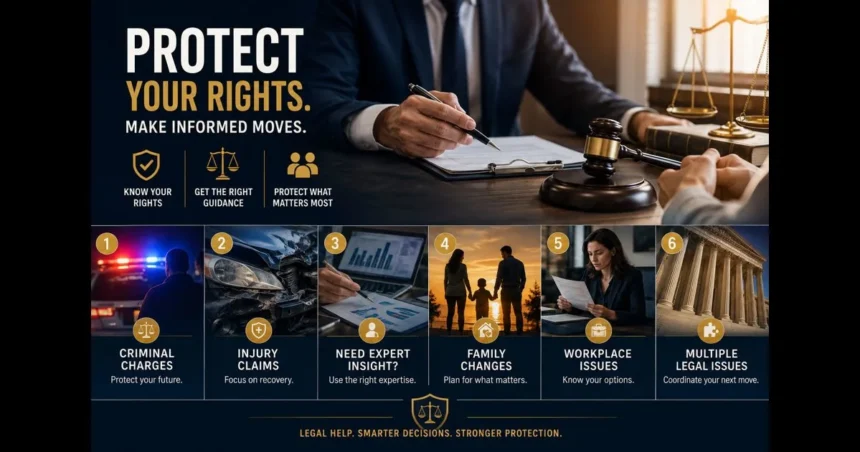
Specialized help is not a substitute for common sense, and it is not necessary for every disagreement. But the right kind of guidance can help a person slow down, preserve useful information, and separate urgent action from pressure-driven action. Below are six situations where it may be sensible to ask whether the issue calls for a lawyer in a particular field—or, in some cases, a technical expert working with counsel.
1. You have been accused of a crime, especially after another stressful event
An allegation arising from a traffic stop, a dispute at home, a store incident, or an online interaction can have effects beyond the criminal case itself. Driving privileges, employment, professional licensing, family relationships, and immigration circumstances may all be concerns. The facts and legal rules differ widely by charge and location, so advice from a generic online forum is a weak substitute for case-specific counsel.
The practical next move is to save every charging document, release paper, court notice, and property receipt; write down your recollection while it is fresh; and avoid discussing the allegations publicly. Do not assume that a criminal matter will resolve itself because the original incident seems minor.
For someone with a Michigan criminal matter, Criminal Defense Law Center West Michigan describes criminal-defense services in West Michigan, including OWI/DUI, drug, theft, domestic-violence, violent-crime, and other charges. The relevant lawyer can explain the process in the appropriate court and identify questions that may require separate guidance. Promptly seeking information is different from assuming an outcome.
2. An injury is competing with insurance calls and evidence concerns
After a car, motorcycle, or truck crash, a fall, a pedestrian incident, or another serious injury, health and safety come first. Once immediate care is addressed, documentation becomes important. Photographs, contact details for witnesses, incident reports, medical records, repair information, and communications with insurers may later help establish what happened and what losses are claimed.
Be careful with quick, broad statements about fault or medical recovery. You can provide truthful information without guessing. Before accepting a release, settlement document, or recorded statement, understand what it says and whether it affects rights you may not be able to restore later.
People dealing with a potential injury claim in Northeast Georgia or the metro Atlanta area may review the information provided by Parisi Law Firm, which describes Georgia personal-injury work involving vehicle accidents, premises incidents, dog bites, catastrophic injury, and wrongful death. A lawyer can discuss the civil process and the records relevant to a specific claim. No article can predict whether a particular matter will result in compensation.
3. The dispute depends on knowledge outside the law
Some cases turn on questions a judge or jury cannot answer from ordinary experience alone: Did an event medically cause a condition? What income was lost? What was a business worth? Did a construction-safety practice meet a relevant standard? The legal case may need an opinion from someone with training in the particular discipline.
That does not mean an expert is automatically needed, or that every expert opinion will be allowed in court. Qualifications, methods, case facts, court rules, conflicts, and timing matter. It also does not mean an expert replaces a lawyer. The lawyer addresses legal duties, procedure, and advocacy; the expert addresses a defined technical subject.
West Coast Expert Witness describes a medical and financial expert-witness service and network serving California, Washington, and Oregon, with state and federal court work. Its publicly described disciplines include medical causation, economic damages, forensic psychology, toxicology, accounting, valuation, and construction-related fields. In a matter where specialized evidence may be important, counsel can help determine whether an expert review is appropriate and what role it should serve.
4. A family change may affect children, property, or future plans
Separation, divorce, a custody disagreement, adoption, or a request to change an existing order can combine emotional stress with decisions that have long-term consequences. Parenting time, support, living arrangements, insurance, joint accounts, property, businesses, and estate documents may all need attention. A verbal understanding may feel workable now but can be hard to enforce later, particularly when it conflicts with a court order.
A useful first step is to collect current orders, financial documents, important messages, and a neutral record of schedules or expenses. Avoid using children as messengers or making major changes based only on informal advice. If safety is a concern, seek appropriate immediate support and legal guidance.
In Columbia and elsewhere in South Carolina, Warner Law describes family-law services covering divorce, custody and visitation, support, adoptions, modifications and enforcement, prenuptial agreements, probate or estate litigation, and LGBTQ family matters. The details of residency, existing orders, and family circumstances can affect the correct forum and available options, which is why tailored advice matters.
5. A job problem is tied to income, a contract, or immigration concerns
A troubling workplace event is not always just an internal human-resources issue. An employee may have questions about unpaid wages, discrimination, harassment, retaliation, termination, a severance proposal, or an employment contract. For immigrant workers, an employment change can also raise separate concerns about a visa, petition, work authorization, or other immigration matter.
Start by retaining records you are entitled to keep: pay stubs, schedules, job offers, performance reviews, benefit information, and communications about the dispute. Keep notes with dates and participants. Do not destroy information or take proprietary files you are not authorized to possess. If a document requires a quick signature, ask what the deadline means rather than treating urgency as an answer.
Joya Law Firm describes representation of employees in New York City and New York State for issues including wage disputes, discrimination, retaliation, harassment, termination, severance, and contracts, along with immigration services nationwide. Its California office is described as handling federal immigration practice. A coordinated question for counsel is not “Will one problem automatically solve the other?” but “Which decision affects which legal track, and who is advising on each one?”
6. One incident has created more than one legal track
This final situation is the most easily missed. A single event can create a criminal allegation, a family-law concern, an injury claim, and financial consequences. The answer is not necessarily to hire multiple firms immediately. It is to identify the tracks before one deadline, statement, or agreement creates unintended effects elsewhere.
For example, a Western Montana resident confronting a criminal charge during a family transition may need to understand both issues before making commitments about parenting, finances, or court appearances. A&M Law describes criminal defense, cooperative family law, family law, and personal-injury services in Missoula and surrounding Western Montana communities. A direct conversation about the facts can clarify the firm’s possible role and whether other counsel or professionals are needed.
In any multi-part matter, make a simple one-page case sheet: agencies or courts involved, names and contact information, dates, documents, and the question connected to each track. Ask every professional for a clear engagement scope. With permission and attention to confidentiality, professionals can sometimes coordinate information; do not assume that they can or should share everything automatically.
The best protection for your next move is often disciplined preparation. Preserve what matters, avoid rushed assumptions, and seek advice from a professional whose jurisdiction and field match the decision in front of you. Specialized help cannot remove uncertainty, but it can help you understand it before acting.
General-information disclaimer: This article provides general educational information and is not legal advice. It does not create an attorney-client relationship or endorse any particular professional. Laws, procedures, and deadlines depend on the facts and jurisdiction; consult a lawyer licensed for your situation.