






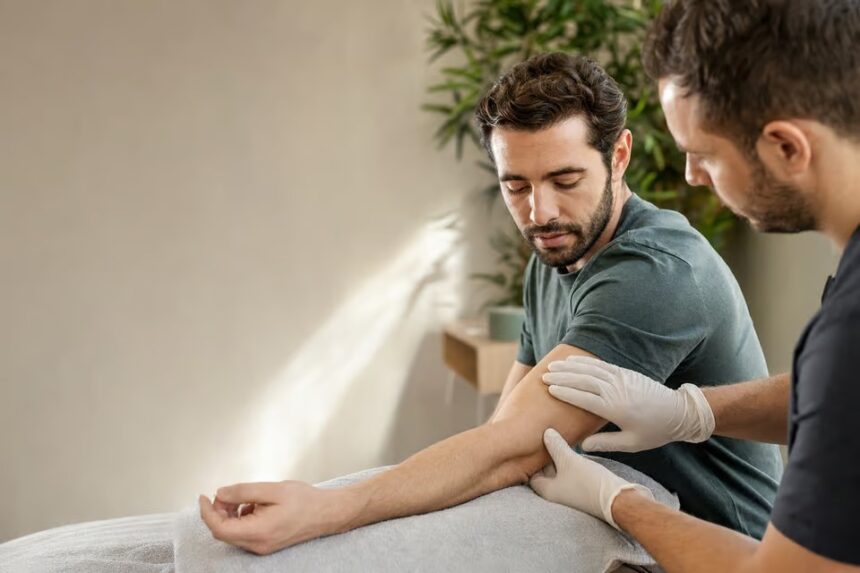
Elbow pain is deceptive to begin with. It starts by causing a dull ache when you do something as little as holding a tennis racket and go about your daily activities, such as opening a door, holding your phone, and find it painful. But while seeking tennis elbow treatment Dubai, most individuals target the elbow and ignore the other parts of the body. Treating a system isolated to the elbow will not solve the mechanical dysfunctions of the body.
Elbow pain is most successfully treated when the entire body is evaluated. The human skeleton consists of joints that are constantly moving and are connected to each other. If one joint begins to fail, other joints must compensate and are burdened with moving extra weight.
The Biomechanical Compensation Link
It is common for patients to develop pain in the outer elbow after sustaining a low limb injury and undergoing a knee replacement surgery. If a patient has arthritis in a knee and is unable to bear weight on it, they will use the upper body to assist in getting out of a chair, stabilize on a handrail, and use crutches.
This stress on the elbow extensor muscles leads to the pain and micro-tears of lateral epicondylitis.
The best physiotherapy clinics in Dubai will not simply give a patient an ice pack and a brace to wear. The staff will assess the movement patterns of the body and locate areas of the body that are bearing extra weight, the source of the injury, and overload. There is no comparison for the effectiveness of the integrated approach of the Kinetic Chain to an approach that treats a specific region of the body:
| Rehabilitation Element | Localized Elbow Treatments | Integrated Kinetic Chain Rehab |
| Primary Focus | Symptom management (ice, rest, braces). | Root cause correction (shoulder, spine, and wrist mechanics). |
| Tendon Physiology | Left to heal passively through rest. | Actively loaded to stimulate collagen repair. |
| Postural Impact | Ignored during upper limb treatment. | Monitored to address compensations from lower-limb injuries. |
| Long-Term Success | High rate of pain recurrence upon return to sport. | Restored tissue tolerance and permanent pain relief. |
Physiotherapy Methods That Target the Root Cause
To achieve a lasting remedy, the tennis elbow physiotherapy has to follow a planned series of therapeutic loads. Tendons have a very poor blood supply when compared to muscles, therefore, tendons need a controlled mechanical tension to undergo repair:
- Isometric Loading (Pain Relief Phase): This involves holding a weight or resistance in a fixed position for 30 to 45 seconds with no movement. This is usually done with a resisted wrist extension. This is done by holding the static position to the pain free position of the muscle, which provides pain relief. This allows the tendon to get accustomed to the load while protecting the joint from unnecessary irritation.
- Progressive Eccentric Exercise (The Tissue-Rebuilding Phase): This phase encourages slow lengthening of the muscle when eccentric loads are applied. For instance, you might use your uninjured hand to make a lift, and then slowly lower the weight, taking 4 to 6 seconds to lower the weight using the recovering forearm. Targeted eccentric tension that is applied to the tendon sends a mechanical signal to the disorganized, frayed collagen that is present in the tendon and helps align the collagen in a parallel fashion with the structural integrity of the tendon.
- Scapular and Shoulder Stabilization (The Offloading Phase): An elbow cannot function effectively in isolation, and this phase of rehabilitation addresses the upper back stabilizers, and in particular, the mid-trapezius, serratus anterior, and the rotator cuff. When the stabilizers of the shoulder blade are reinforced, the shoulder will carry the mechanical stress of dynamic activities (such as a padel stroke when the forearm and shoulder undertake sudden and large mechanical stress) and leave the small muscles and stabilizers of the forearm stress-free and unoverloaded.
When conservative care fails at controlling the pain that is caused by the injury, then a logical step is to obtain a consultation with an orthopedic surgeon in Dubai to determine if the tendon integrity is compromised.
Restoring Balanced Movement
Recovering from chronic tendon pain needs an active and targeted approach to both the skeleton and muscle. Focusing on local approaches to treat the pain will ensure that the pain will return when the physical activity is resumed to full capacity.
Be it upper-body tendon overload or long-term knee pain treatment, realigning your structures while strengthening your dynamic stabilizers is the only way to move with confidence without restraints.