






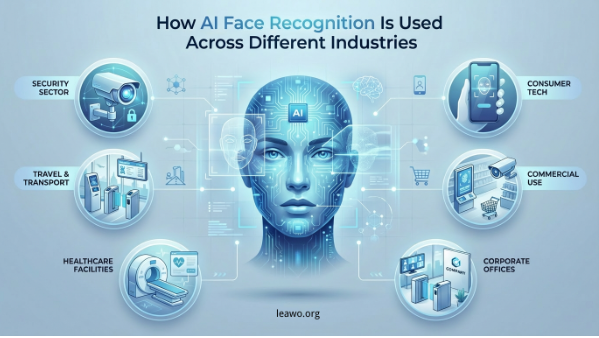
Artificial intelligence has transformed the way machines understand and interact with the world, and one of the most impactful breakthroughs is face recognition. What once felt like science fiction is now a part of everyday life—from unlocking smartphones to passing through airport security without showing a passport. As AI face recognition technology continues to evolve, its adoption has expanded rapidly across multiple industries, reshaping security, consumer electronics, media, transportation, and more.
This article explores how face recognition AI works, where it’s being used today, the benefits it brings, and the challenges that come with such powerful technology. More importantly, it highlights why responsible and ethical adoption is essential as AI becomes more deeply embedded in society.
1. What Is AI Face Recognition and How Does It Work?
At its core, AI face recognition is a technology that identifies or verifies a person’s identity using their facial features. Unlike traditional image matching, modern systems rely on artificial intelligence to analyze complex patterns in facial data.
How Face Recognition AI Works
The process generally involves several key steps:
- Face Detection
The system first locates a face within an image or video frame. AI models are trained to recognize facial structures such as eyes, nose, mouth, and jawline. - Feature Extraction
Once detected, the AI analyzes unique facial landmarks—distances between eyes, shape of cheekbones, contours of the lips, and more. These features are converted into a mathematical representation called a face embedding. - Face Analysis and Matching
The extracted data is compared against stored facial profiles in a database. If a match is found within a certain confidence threshold, the identity is confirmed.
Unlike simple photo comparison, face recognition AI can adapt to changes in facial expression, aging, hairstyles, and even partial obstructions like glasses or masks.
2. AI Face Recognition in Security and Surveillance
One of the most prominent uses of face recognition technology is in security and surveillance. Public and private sectors alike leverage AI to enhance safety and access control.
Access Control and Building Security
In offices, residential complexes, and secure facilities, facial identification is replacing keycards and passwords. Employees or residents can gain entry simply by showing their face, reducing the risk of stolen credentials and unauthorized access.
Public Safety and Surveillance Systems
Law enforcement agencies use AI-powered facial recognition to:
- Identify suspects in criminal investigations
- Locate missing persons
- Monitor high-risk areas in real time
When used responsibly and within legal frameworks, these systems can significantly improve response times and situational awareness.
However, this area also raises serious privacy concerns, making transparency and regulation critical.
3. AI Face Recognition in Consumer Electronics
For most people, daily interaction with face recognition happens through consumer electronics. Smartphones, tablets, and smart devices increasingly rely on facial authentication.
Face Unlock and App Security
Face unlock features allow users to access their phones or apps instantly without typing passwords. Compared to fingerprints or PIN codes, facial authentication feels more natural and frictionless.
Personalized Shopping and Payments
In retail and e-commerce, face recognition AI enables:
- Personalized product recommendations
- Faster checkout through facial payment systems
- Enhanced fraud detection during online purchases
By recognizing returning users, platforms can tailor experiences while improving transaction security.
4. AI Face Recognition in Photo and Video Editing
The creative industry has embraced AI face recognition as a powerful tool for photo and video enhancement. Modern editing software can now identify faces automatically and apply precise adjustments that once required manual retouching.
AI Portrait Enhancement
AI-powered tools can detect facial features and improve them intelligently—adjusting skin tone, smoothing textures, sharpening eyes, and correcting lighting. Software like Leawo Photo Enhancer uses face recognition AI to enhance portraits while preserving natural details.
Facial Feature Adjustment and Effects
Face recognition enables targeted edits such as:
- Retouching facial expressions
- Adjusting symmetry
- Enhancing specific features like eyes or lips
For example, creators can easily enlarge eyes in portrait photos for artistic or aesthetic purposes without distorting the rest of the image.
AI Face Swap Technology
AI face swap technology also relies on facial recognition to map one face onto another in photos or videos. While popular in entertainment and social media, it raises ethical concerns when used without consent or for deceptive purposes.
5. AI Face Recognition in Transportation
Transportation is another industry where face recognition AI is transforming user experiences and operational efficiency.
Airports and Border Control
Many international airports now use facial recognition for:
- Check-in and baggage drop
- Security screening
- Boarding gates
Passengers can move through checkpoints with minimal physical interaction, reducing wait times and improving security accuracy.
Public Transportation Systems
In some cities, facial recognition is used for ticketless travel, allowing commuters to pay fares automatically through facial identification. This not only speeds up boarding but also reduces physical contact and fraud.
6. Key Benefits of AI Face Recognition Across Industries
The widespread adoption of face recognition technology is driven by several key advantages.
Reduced Manual Processes and Improved Efficiency
Automating identity verification eliminates repetitive manual tasks. From security checks to customer authentication, AI handles processes faster and with fewer errors.
Enhanced Security and Fraud Prevention
Facial recognition provides an additional layer of security that is difficult to replicate or steal. Unlike passwords, facial features are unique and always present.
Improved User Experience
Convenience is a major benefit. Users can unlock devices, access services, and complete transactions seamlessly—often without even realizing AI is at work.
Scalability and Adaptability
AI systems can scale across millions of users and adapt to new data, making them suitable for both small businesses and global enterprises.
7. Challenges and Ethical Concerns
Despite its benefits, AI face recognition comes with significant challenges that must be addressed.
Privacy and Data Storage Risks
Facial data is highly sensitive. Improper storage, data breaches, or unauthorized use can lead to serious privacy violations. Strong data protection policies and encryption are essential.
Algorithm Bias and Accuracy Issues
Face recognition systems can show bias based on race, gender, or age if trained on unbalanced datasets. This can lead to misidentification and unfair treatment, especially in law enforcement contexts.
Copyright and Ethical Responsibility in AI Face Swap
AI face swap and deepfake technologies raise concerns around consent, misinformation, and identity misuse. Ethical responsibility lies with both developers and users to prevent harmful applications.
Addressing these challenges requires clear regulations, transparent algorithms, and responsible deployment.
8. Conclusion: Responsible Adoption of AI Face Recognition
AI face recognition has become a foundational technology across industries—from security and consumer electronics to creative media and transportation. Its ability to identify, analyze, and enhance facial features has unlocked new levels of efficiency, convenience, and personalization.
However, with great power comes great responsibility. As face recognition AI continues to shape how we interact with technology, ethical considerations around privacy, bias, and consent must remain at the forefront. Responsible adoption, guided by clear regulations and ethical standards, is essential to ensure this technology benefits society as a whole.
When implemented thoughtfully, AI face recognition has the potential to improve safety, streamline daily life, and enhance creativity—while respecting the rights and dignity of individuals in an increasingly digital world.